
Project Overview
Can structured content and targeted search optimisation help a brand become more discoverable in Google — and improve how AI-powered search describes it?
Our work with Raja Thai explored both opportunities through practical implementation and continuous measurement.
The project combined technical SEO, structured content development, Google Search Console workflows and RTAER (Raja Thai AI Entity Reclassification), a dedicated framework for monitoring changes in AI-powered brand recognition, descriptions and citations.
Two areas became especially interesting: the growth in Raja Thai's Google Search presence and the changes observed in how AI-generated responses presented the brand.
site: results5–16 October 2026
5–19 October 2026
and follow-up measurement
1. The Starting Point
Raja Thai was developing its official website with product information, ingredient explanations, formulation content and frequently asked questions.
Our initial focus was to strengthen the website's content structure and help Google discover its pages more effectively.
On 5 October 2026, a Google site:rajathai.com query displayed approximately 7 results.
Separately, RTAER assessments had been conducted since August to establish a baseline for AI Search brand recognition.
August–September: Establishing the Baseline
During this period, the emphasis was on monitoring and understanding how AI-powered search described Raja Thai.
The early assessments helped identify opportunities to strengthen official brand information, content relationships and citation visibility.
These observations became the reference point for subsequent optimisation work.
OCTOBER IMPLEMENTATION
2. October: From Monitoring to Implementation
In October, the project moved into a more active implementation phase.
We focused on:
- Strengthening official product and brand content.
- Expanding supporting ingredient, formulation and FAQ pages.
- Improving content relationships and technical accessibility.
- Validating selected pages through Google Search Console.
- Monitoring subsequent indexing and AI Search observations.
This provided a more structured foundation for both conventional search visibility and AI-powered brand discovery.
3. Google Search Visibility: 7 to 24 Results
The following progress was documented:
| Date | Google Search observation |
|---|---|
| 5 October | Approximately 7 visible results |
| 10 October | Eight selected URLs completed the indexing workflow |
| 12 October | All eight URLs confirmed indexed |
| 16 October, early morning | Approximately 15 visible results |
| 16 October, later morning | Approximately 24 visible results |
Across these checkpoints, Raja Thai's visible Google site: results increased from approximately 7 to 24, representing around 3.4× the initial count.
The rapid change observed on 16 October was particularly useful for understanding the relationship between publishing activity, indexing checks and subsequent search appearance.
The figures represent Google site: search observations, supplemented by URL-level Google Search Console validation.
4. RTAER: Observing Changes in AI Brand Perception
RTAER — Raja Thai AI Entity Reclassification is our recurring assessment framework for tracking how AI-powered search experiences recognise, classify and describe Raja Thai.
The assessment considers brand recognition, factual accuracy, official website references and consistency across a defined query set.
From Earlier AI Responses to More Neutral Brand Descriptions
One of the most useful parts of the project was comparing AI-generated descriptions at different checkpoints.
Earlier observations included responses with negative or incomplete framing around the brand.
Following the October content and search optimisation work, later observations provided an opportunity to examine how those descriptions had evolved.
FROM AI PERCEPTION TO MEASURABLE CHANGE
Same query. Same platform. Three dated observations.
Google AI Mode · apa itu kopi raja thai
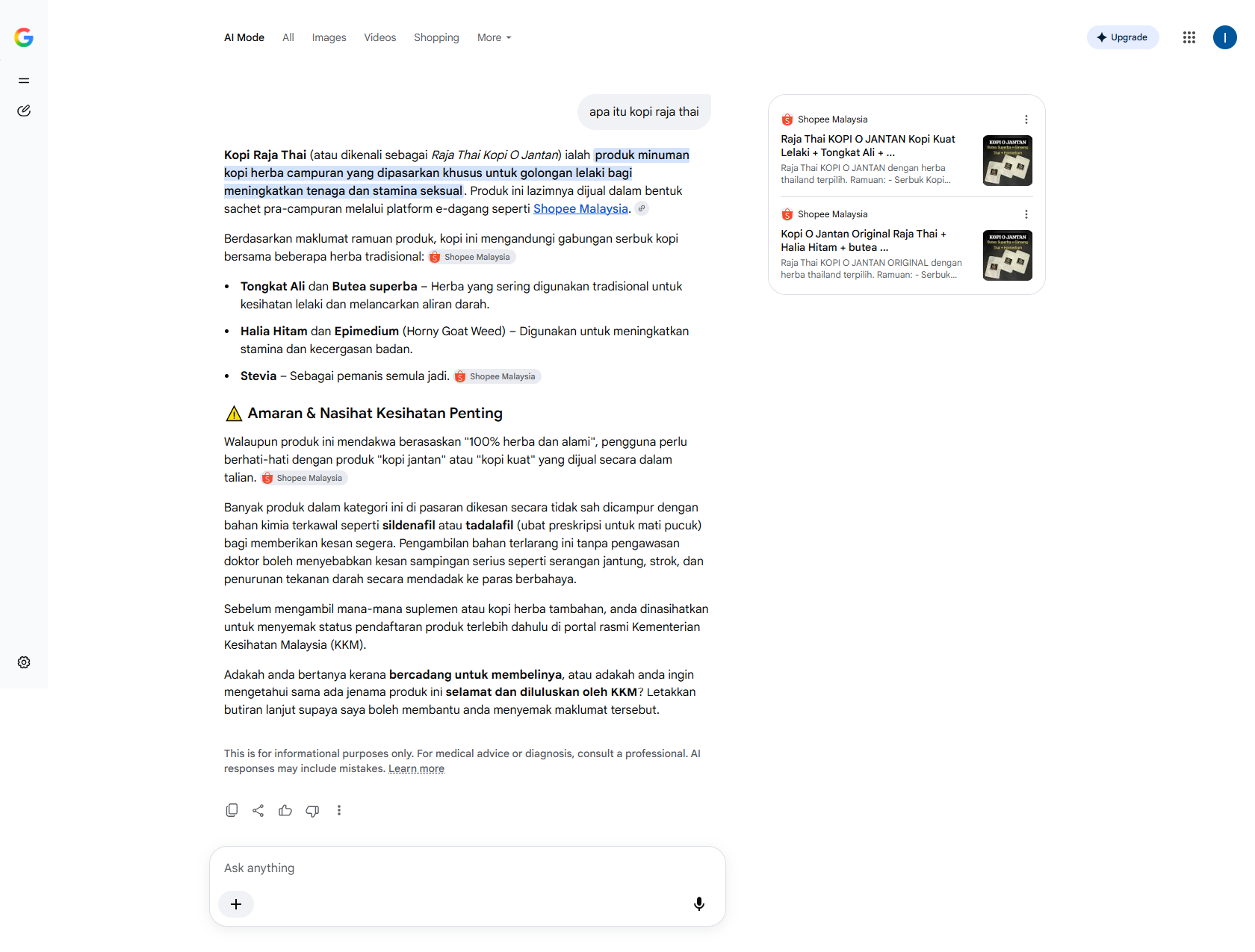
Query:
apa itu kopi raja thaiThe response framed the product through marketplace descriptions and a prominent category-level warning.
View full original screenshot ↗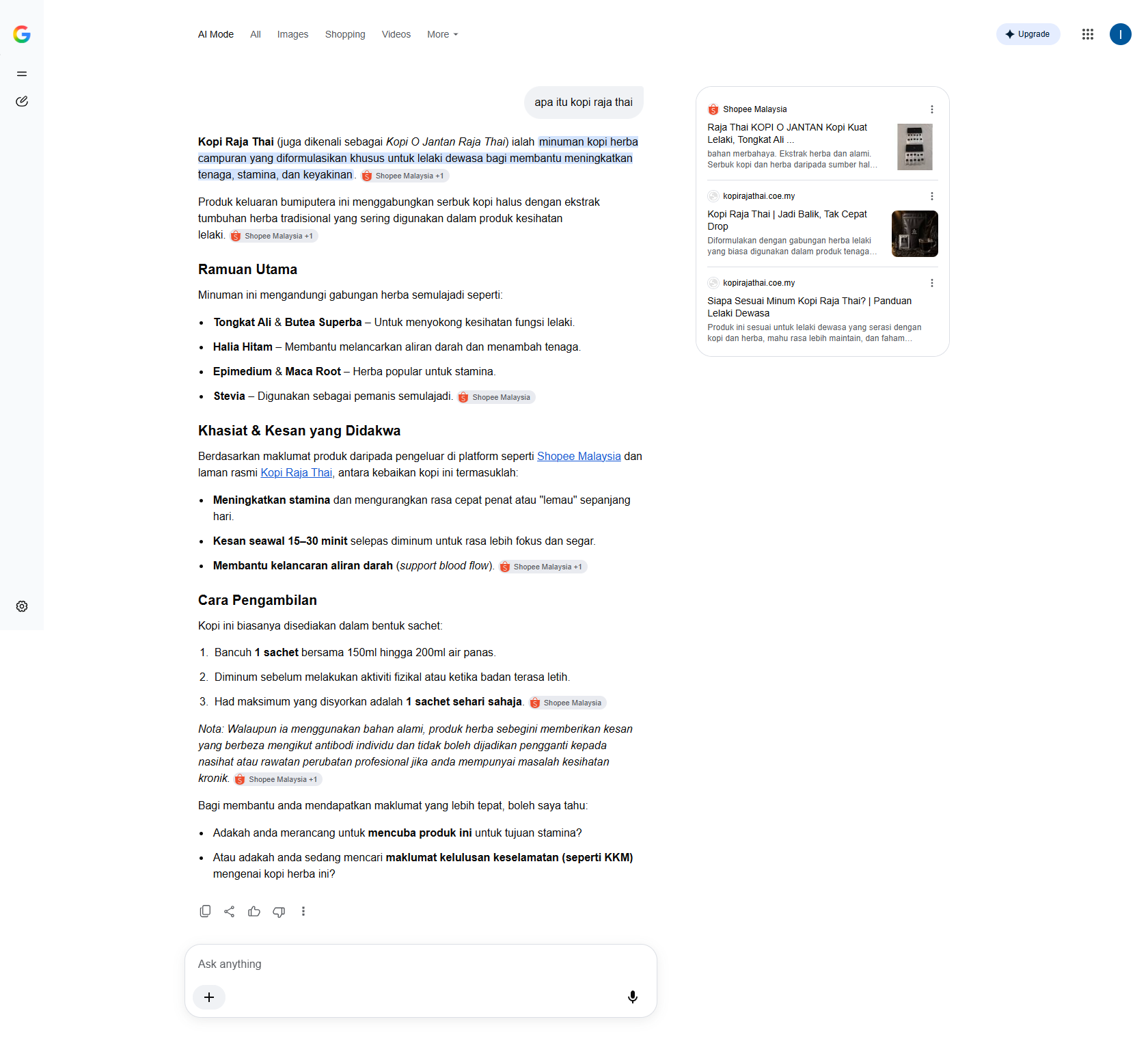
Query:
apa itu kopi raja thaiThe response used a more neutral product-and-ingredient explanation, with brand-owned pages visible among the sources.
View full original screenshot ↗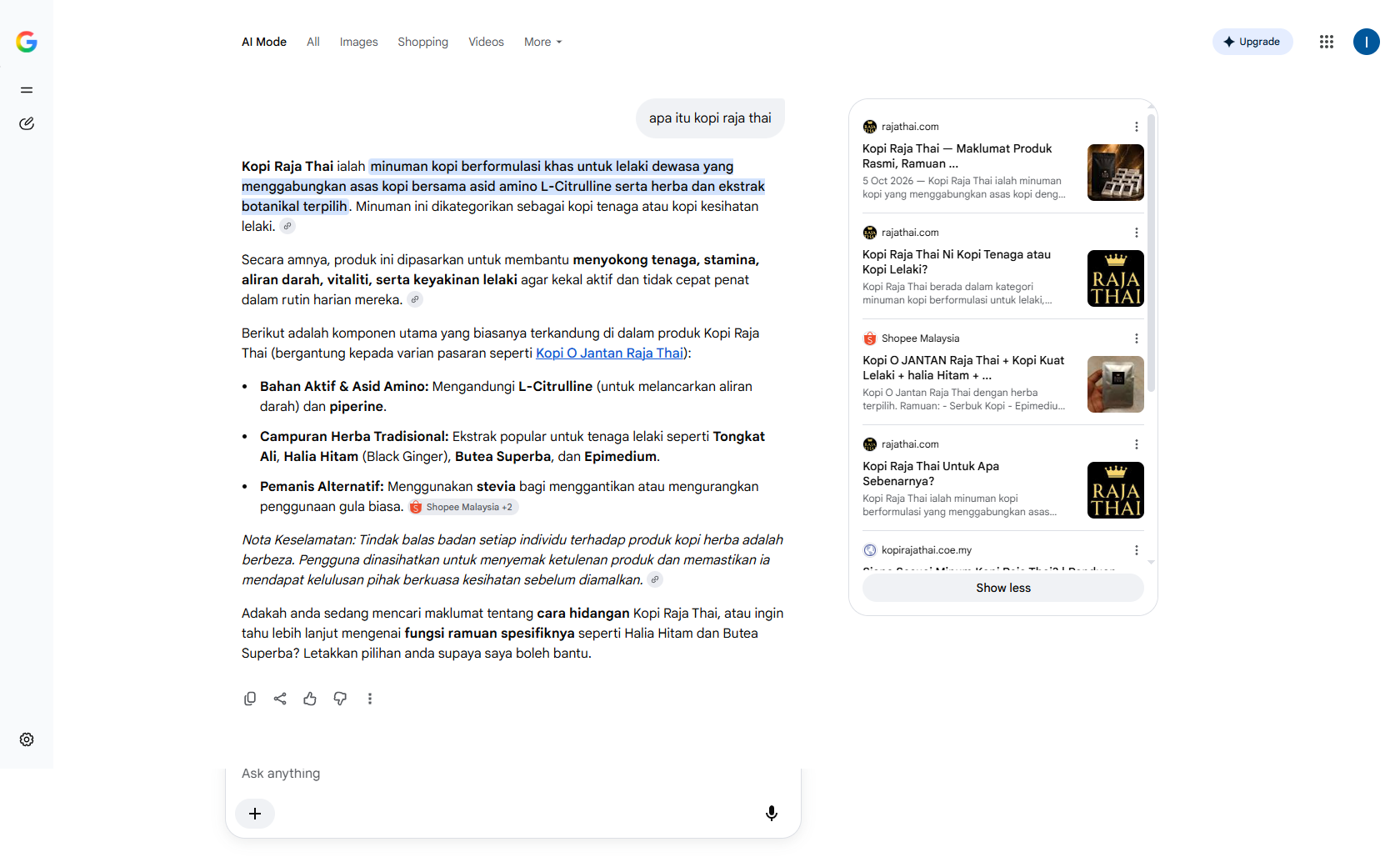
Query:
apa itu kopi raja thaiThe explanation explicitly included L-Citrulline and selected botanical extracts, alongside multiple rajathai.com references.
View full original screenshot ↗By presenting the original responses side by side, visitors can see the actual wording and how the brand was represented at each checkpoint.
This comparison is especially valuable because it makes AI Search optimisation more tangible than an abstract technical description.
RTAER Measurement Progress
August–September monitoring baseline → October implementation checkpoints
| Assessment | RTAER score |
|---|---|
| — Monitoring baseline | 8/100 |
| — Monitoring | 13/100 |
| — Monitoring | 13/100 |
| — Monitoring | 12/100 |
| — October checkpoint | 31/100 |
| — Follow-up assessment | 36/100 |
| — Latest assessment | 40/100 |
The RTAER score increased from 31/100 on 5 October to 40/100 on 19 October, alongside the project's October implementation and monitoring activities.
The earlier August–September observations provide historical context, while the October checkpoints highlight the more recent period of active work.
Together, the screenshots and recurring measurements help illustrate the evolution of Raja Thai's representation in AI-powered search.
5. What We Learned
The Raja Thai project demonstrates how several search visibility activities can work together.
Technical SEO supports discovery. A clear website structure, accessible pages and systematic indexing checks provide a stronger foundation for Google Search.
Content supports brand understanding. Official product information and interconnected educational content give search systems clearer context about the brand.
AI Search visibility can be measured over time. Repeated assessments and original response screenshots make changes in brand descriptions, recognition and citations easier to observe and evaluate.
6. Continuing the Work
Raja Thai remains an active project.
We continue to expand relevant content, review Google indexing progress and assess AI-generated brand descriptions using the RTAER framework.
Future checkpoints will be incorporated as new findings are verified.
7. Bringing This Approach to Your Business
Search visibility today extends beyond appearing in conventional search results.
Businesses also benefit from understanding how AI-powered search recognises their brand, interprets their information and references their official website.
At COE.my, we bring together technical SEO, structured content and practical AI Search monitoring to help businesses strengthen their digital presence.
Ongoing case study · Updated through .